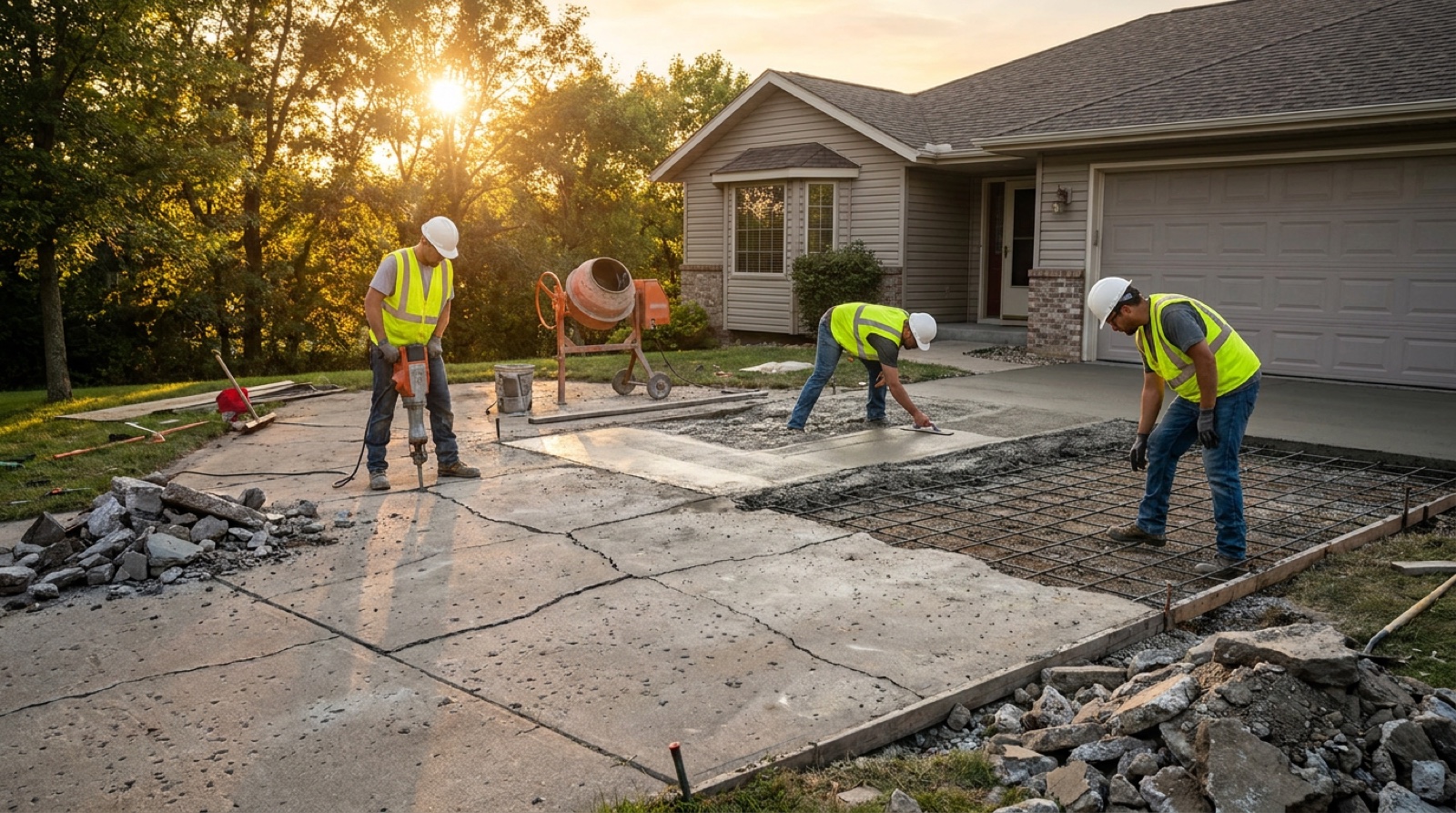
If your driveway has cracks under a quarter inch wide, the slab sits level, and the surface is otherwise sound, repair is the right call. If cracks are wider than half an inch, sections have shifted vertically, or you have failures spread across multiple areas, replacement is cheaper over any reasonable timeline.
Everything else falls somewhere in between. Here is how to figure out where your driveway lands.
Start With the Cracks
Crack width is the fastest diagnostic you have. Grab a tape measure and check the widest point of the worst crack.
| Crack width | What it means | Action |
|---|---|---|
| Under 1/8 inch | Normal shrinkage or curing cracks | Seal to keep water out |
| 1/8 to 1/4 inch | Minor movement, stable slab | Rout and fill |
| 1/4 to 1/2 inch | Real movement below the slab | Investigate the cause, then repair |
| Over 1/2 inch | Base failure or structural cracking | Usually replacement |
Width alone does not settle it. A hairline crack that runs the full width of the driveway and has one side sitting higher than the other is worse than a wide crack with both sides flush.
Vertical displacement is the dealbreaker
Run your foot across the crack. If one side has lifted or dropped more than a quarter inch, the ground underneath has moved.
Patching that does nothing. The soil will keep moving and the patch will fail within a season or two.
What Causes Driveway Failure Around Here
Redding sits on a mix of clay and decomposed granite soils, and both behave badly under a slab when moisture swings hard. Our summers run past 100 degrees for weeks, then the winter rain saturates the same ground.
That expansion and contraction cycle is the single biggest cause of driveway failure across Shasta County. Tree roots come second, particularly from the valley oaks that shade so many older Redding properties.
Poor original prep is the third. A slab poured on unstable fill with no compaction will crack no matter how good the concrete was.
Cost Comparison
These are typical ranges for the north state. Your actual numbers depend on access, slab thickness, and how much demolition is involved.
| Option | Typical cost | Lifespan added |
|---|---|---|
| Crack sealing | $300 to $800 | 3 to 5 years |
| Slab jacking or leveling | $700 to $2,500 | 5 to 10 years |
| Resurfacing (overlay) | $3 to $7 per sq ft | 8 to 15 years |
| Full tear out and repour | $8 to $15 per sq ft | 30 to 40 years |
Run the math on cost per year of service, not on the sticker price. A $2,000 repair that buys five years costs more annually than a $9,000 replacement that lasts thirty.
Where Resurfacing Fits
Resurfacing means bonding a new layer of concrete or polymer overlay over the existing slab. It fixes appearance and surface texture, and it can hide spalling, discoloration, and a network of small cracks.
It does not fix anything structural. The overlay is only as stable as the slab beneath it.
Resurfacing works when:
- The slab is level with no vertical displacement
- Cracks are cosmetic and under a quarter inch
- The surface is worn, flaking, or stained but the concrete is solid
- You want a decorative finish without the cost of a full pour
Resurfacing fails when:
- The base underneath is unstable
- Existing cracks are active and still moving
- The slab is under four inches thick and carrying vehicle loads
Overlays also open the door to a stamped or textured finish at a fraction of what a decorative repour would run. That is worth considering if the driveway is functionally fine but looks tired.
When Replacement Is Clearly the Answer
Some driveways are past the point where repair math works. Replace if any of these apply.
- Cracks over half an inch across multiple sections
- Any vertical displacement over a quarter inch
- Water pools on the surface after rain, meaning the grade has failed
- The slab is more than 35 years old and has been patched repeatedly
- Sections rock or move when a vehicle drives over them
- Crumbling and spalling across more than 20 percent of the surface
Replacement also gives you the chance to correct problems the original installer left behind. Proper base compaction, a thicker slab where vehicles turn, and control joints cut at the right spacing all extend service life significantly.
If your driveway needs to come out, the demolition and haul away is normally quoted as part of the job rather than separately.
The Middle Ground
Plenty of driveways have one bad section and three good ones. Partial replacement is a legitimate option when the failure is confined and the control joints give you a clean line to cut on.
Expect a visible color difference between old and new concrete. It fades over two to three years but never disappears entirely.
Get the cause diagnosed first
Any repair done without identifying why the slab failed is a temporary fix. Drainage that dumps roof runoff at the driveway edge, an irrigation leak, or a root system under the slab will all defeat good concrete work.
Fix the water or the roots first. Sometimes that means adding a retaining structure or regrading before any concrete gets poured.
How to Decide
Walk the driveway with a tape measure and write down the widest crack, any height differences, and where water sits after rain. Those three data points settle most cases.
If the numbers put you in repair territory, a targeted repair will buy you real years. If they put you in replacement territory, spending money on patches is throwing it away.
We handle both across Redding, Anderson, Shasta Lake, and Red Bluff, and we will tell you which one your driveway actually needs. Look at our driveway installation work to see what a properly prepped pour looks like, or get in touch for a free assessment and a written quote.